RESEARCH
My research is equal parts software development and physics investigation.
I identify important physical questions beyond our current simulation capabilities and determine
what needs to be included in our simulations to answer them. Recently, I have focused on
accurately modeling hydrogen-rich ejecta and capturing the full range of light-matter interactions
relevant to core-collapse supernova radiative transfer simulations.
I am also working on accurately incorporating sophisticated helium recombination into the TARDIS plasma model.
A number of helium absorption features appear in stripped-envelope supernovae from energy states
we would not naively expect given the plasma temperatures. These features are understood to arise
from high-energy electrons colliding with and ionizing helium, which then recombines into excited
states that interact with light and produces the spectral features we observe.
Much of my PhD work was spent
examining supernova remnants in search of surviving companions of Type Ia supernovae. The rest
was spent developing the open-source STARDIS code,
which simulates light propagating through stellar atmospheres to help us understand stellar structure and composition. I have spent considerable
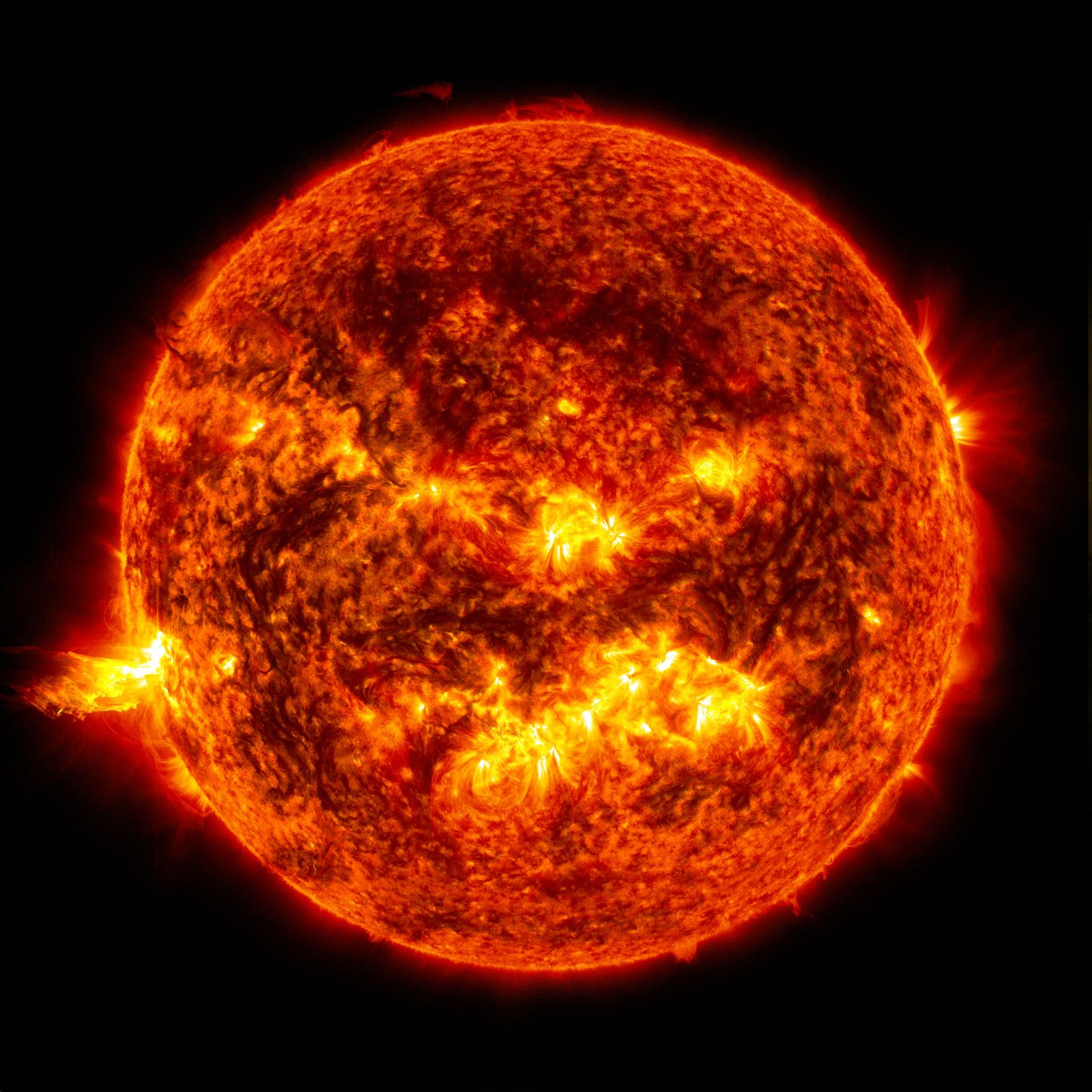
time studying the Sun to ensure we capture the relevant physics in its atmosphere.
I performed a systematic surviving companion search of the SNR 0509-67.5 remnant in the Large Magellanic Cloud
by combining archival Hubble Space Telescope imaging with Bayesian inference of astrophysical parameters
of the enclosed stellar population.
I also completed a project investigating the stellar population in the SN1006 remnant, using
multi-year baseline astrometry to recover proper motions of faint stars and test one of
the most promising recent Type Ia progenitor scenarios. Read that paper
here!
Before coming to MSU, I worked with the ASAS-SN team to
discover new supernovae and other transients in low-redshift galaxies.